
Kimi K3.1 Pro vs DeepSeek V4.1 Flash Abliterated: Forty Points Apart on Terminal Work, and a Rate Card the Edit Cannot Touch
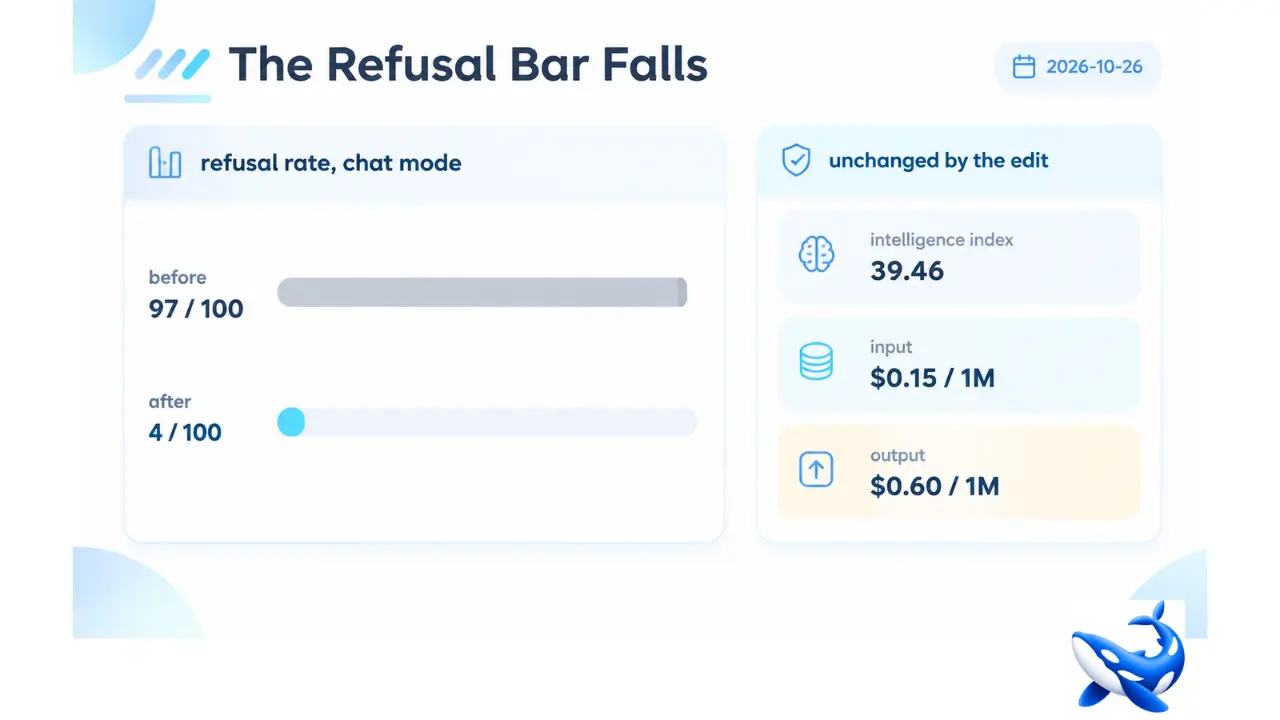
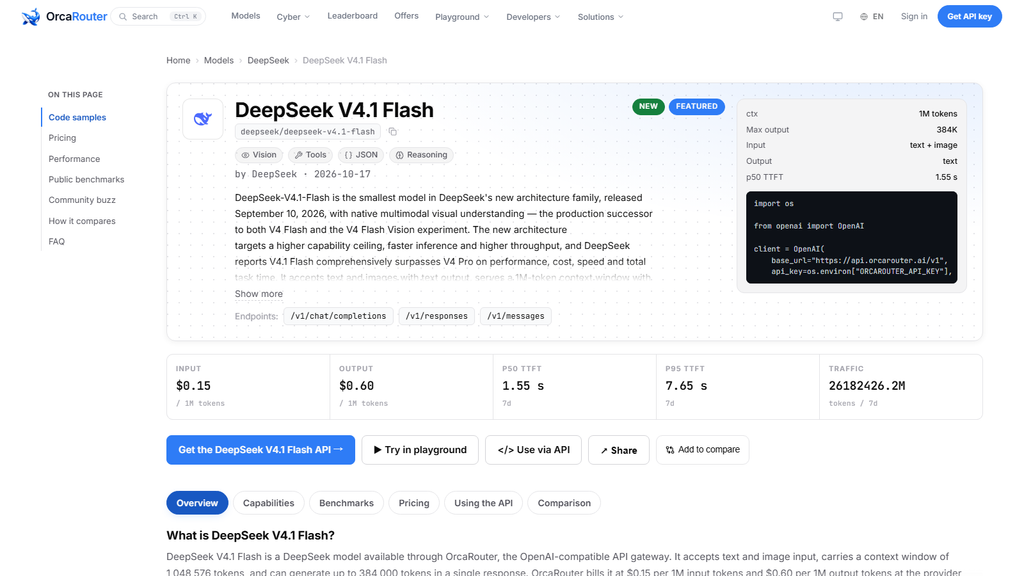
DeepSeek V4.1 Flash Abliterated is a weight edit wearing a model name. The base is DeepSeek’s 552-billion-parameter V4.1 Flash — 16 billion active, MIT-licensed, downloadable since 10 September [INDEPENDENT, Artificial Analysis; VENDOR, DeepSeek model card]. The edit removes the directions the model refuses along, and the publisher’s card reports refusals on 100 held-out harmful prompts falling from 97 to 4 [VENDOR, published model card, 17 October]. The OrcaRouter catalogue shows both sides at once. DeepSeek V4.1 Flash Abliterated is listed there at $0.80/$1.60 per million with a $0.15 cache read — the hosted build, carrying our own CyberGym 88.1 and SEC-Bench Pro 62.8 — while the MIT base it was edited from travels on a $0.15/$0.60 card [OURS, catalogue, 26 October; VENDOR, DeepSeek card]. Kimi K3.1 Pro records 55.09 on the independent index against the base checkpoint’s 39.46, at 13.3× the input rate and 16.7× the output [INDEPENDENT, index v4.3.2, 26 October].
Whether the edit moves that arithmetic is the only question worth asking. It does not: every term that decides a budget — parameter count, context window, token rate, index score — belongs to the base checkpoint, because the edit rewrites a few matrices and leaves the rest byte-identical. Both builds publish the same evidence shape: refusals before, refusals after, no capability benchmark. Kimi K3.1 Pro took the opposite trade and printed its number.
What the edit actually is
Abliteration is a poor name for what happens. Nothing is retrained: the builders locate a direction that correlates with refusal and subtract it from the weights carrying it, with no gradients, no fine-tuning corpus, no architecture change. The first build landed on 10 September, the day the base checkpoint shipped: 48 shards, 510.297 GB, made with the open-source Heretic tool, which leaves expert, Engram and vision tensors untouched and takes refusals on 100 public harmful-behaviour examples from 97 to 24 [VENDOR, published model card, 10 September].
The rebuild on the 17 October checkpoint measures refusal directions separately for chat and think prompts per layer, removes a rank-2 refusal subspace from the residual-stream writes of the 40 main layers, and picks per-layer strengths by a search that minimises refusals while holding first-token divergence down [VENDOR, published model card, 17 October]. Refusals fall 97 to 4 in chat, 98 to 9 in think mode. That card sits on DeepSeek’s refreshed checkpoint, which the evaluator scores at 45.10 rather than the 39.46 of the September release the table below uses [INDEPENDENT, 26 October] — the same edit, on two different bases.
The 0.067 divergence is the only side-effect figure either card publishes: how far the output distribution moved on harmless prompts, not whether anything got worse. A Hugging Face search finds 35 repositories under the name, none with a benchmark table [INDEPENDENT, Hugging Face Hub, 26 October].
Side by side
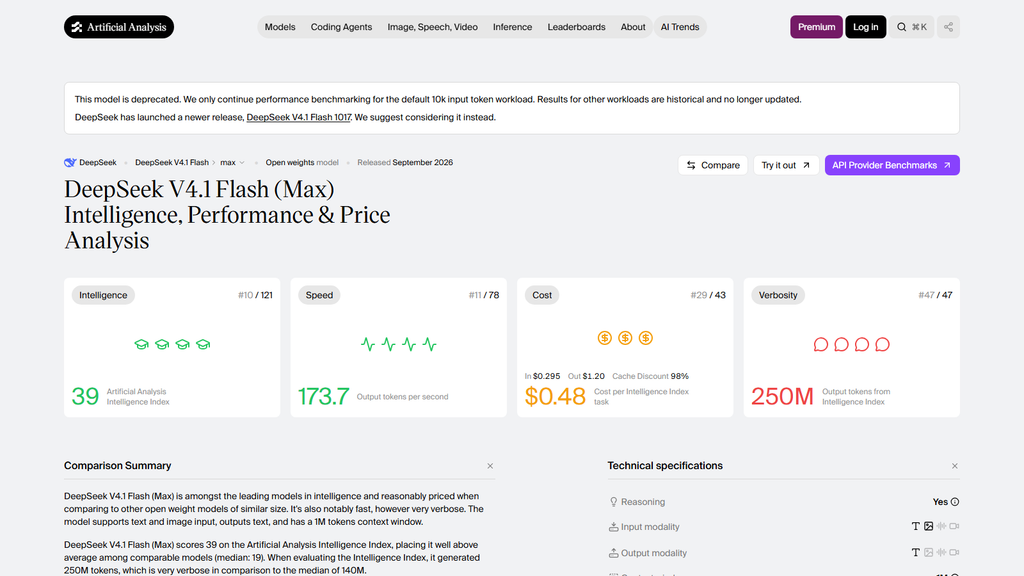
| Kimi K3.1 Pro | DeepSeek V4.1 Flash Abliterated | Gap | |
| AA Intelligence Index | 55.09 | 39.46 | Kimi +15.63 |
| Input / output per 1M | $2.00 / $10.00 | $0.15 / $0.60 | DeepSeek, 13.3× / 16.7× |
| Blended 3:1 per 1M | $4.00 | $0.2625 | DeepSeek, 15.2× |
| Cache read per 1M | $0.20 | $0.003 | DeepSeek, 66.7× |
| Cost per index task | $2.11 | $0.48 | DeepSeek, 4.4× |
| Output tokens per index task | 55,195 | 88,574 | DeepSeek +60.5% |
| Terminal-Bench 4.0 | 67.17% | 26.77% | Kimi +40.40 |
| Hallucination rate | 43.89% | 96.46% | Kimi −52.57 |
| Active parameters | 104B | 16B | DeepSeek, 6.5× fewer |
| Refusals, chat mode | not published | 97 → 4 per 100 | the only measured change |
| Weights | proprietary until 4 Nov | MIT, downloadable | DeepSeek |
| Output speed on our route | 52.4 tok/s | 194.6 tok/s | DeepSeek, 3.7× |
No capability figure in the DeepSeek column is the abliterated build’s own; no publisher has released one. They are the September checkpoint’s — the finding, not a gap. Re-basing the same comparison on the 17 October refresh (45.10) narrows the index gap to 9.99 points and leaves every price row untouched, which is the whole argument in one substitution: the date changes the score, the edit does not.
What has actually been measured
One row has a before-and-after: the refusal row. The evaluator’s leaderboard carries no abliterated entry at all, so its index, terminal score and cost per task describe the checkpoint DeepSeek published; both builders say routed experts, embeddings and vision components are bit-identical. Two published deltas: refusals, and 0.067 of divergence. The rest is extrapolation.
The rate card belongs to the base model
Per token the split is simple: Kimi at $2.00 in and $10.00 out with a $0.20 cache read, the DeepSeek checkpoint at $0.15 and $0.60 with $0.003 [INDEPENDENT, Artificial Analysis; VENDOR, DeepSeek card]. On a 3:1 blend, $4.00 against $0.2625 — 15.2×.
The unit matters more than the ratio. Per index task the same pair is $2.11 against $0.48 — 4.4×. The gap compresses by two thirds; the reason is in the token counts: the DeepSeek run writes 88,574 output tokens per task against Kimi’s 55,195 and reads 1.6× the input. A cheap token only stays cheap if you need fewer of them.
The card also has a clock: $0.15/$0.60 is off-peak, doubling between 01:00 and 04:00 UTC and again between 06:00 and 10:00, so a workload pinned to European or American hours buys $0.30/$1.20 [VENDOR, DeepSeek card] — half that advantage is a scheduling choice.
The hosted build is where “free” stops. On our catalogue the abliterated model is $0.80 in and $1.60 out with a $0.15 cache read — 5.3× the base input rate and 2.7× the output [OURS, 26 October]. That premium is not the edit’s price; it is a service’s. Apply the same subtraction to MIT weights yourself and it costs your GPUs and nothing else; rent a maintained, benchmarked security deployment and the refusal change arrives with its own card. Either way the numbers that describe the model — parameters, context, index, token counts — stay the base checkpoint’s.
Our route agrees. Seven days of the base model: 26.18 trillion tokens, p50 1,549 ms, 194.6 tokens per second, 0.036% errors [OURS, 7-day window, 26 October]. Kimi K3.1 Pro in its first three days: p50 6,752 ms, 52.4 tokens per second [OURS]. Sixteen billion active parameters against 104 explains most of it.
The other trade, declared
Kimi K3.1 Pro shipped with a capability reduction and a number attached: on xdev-bench-hard at pass@3 the released checkpoint scores 81.0% against 90.5% for the same model without its risk-reduction pass — 9.5 points, published, under a named harness [VENDOR, Moonshot release materials].
That is abliteration’s mirror image, and the point is structural, not moral. A declared cut can be priced: you know which capability you are not buying and whether your workload touches it. An undeclared edit lets you price nothing but the refusal rate.
The second asymmetry may be decisive. Kimi K3.1 Pro is not open weights today — the evaluator still marks it proprietary, and the vendor’s commitment is full weights by 4 November [VENDOR; INDEPENDENT, Artificial Analysis, 26 October]. You cannot abliterate it, because you cannot get the tensors. DeepSeek’s checkpoint is MIT and already on the hub, edited by thirty-five repositories in under seven weeks. One trade was handed to you as a number; the other you may make yourself.
The decision, stated plainly
Choose Kimi K3.1 Pro when the work executes something. 67.17% against 26.77% on Terminal-Bench 4.0 is a 40-point margin no retry closes; add 86.33% long-context recall and half the hallucination rate [INDEPENDENT]. You pay 15.2× per blended token and 4.4× per finished task — that compression is the argument.
Choose the DeepSeek checkpoint when the work is volume: classification, extraction, fan-out agent passes, anything a bad answer cannot ruin. At $0.2625 blended, $0.48 an index task and 194.6 tokens per second it is the efficient purchase.
Choose the abliterated build over its base only if you need the behaviour gone. Otherwise it buys nothing: same context, same index, plus 0.067 of divergence on a model somebody else tested. What a host charges is a hosting decision — ours is $0.80/$1.60 against the base’s $0.15/$0.60, and the premium pays for a maintained, benchmarked deployment rather than a different model [OURS].
Route both. A tool loop is Kimi’s; a short, high-volume, checkable call is DeepSeek’s. A bad route costs a worse answer, not a broken one.
The one-line summary
DeepSeek V4.1 Flash Abliterated is the base checkpoint with one behaviour removed and nothing else — same 552 billion parameters, same card, same 39.46 index, refusals down from 97 in 100 to 4 — so against Kimi K3.1 Pro it sits 15.63 index points and 40 points of Terminal-Bench behind, 15.2× cheaper per blended token but 4.4× per task.
Sourcing note: index, component, per-task cost and token-count figures and blended prices are Artificial Analysis on index v4.3.2, read 26 October 2026 — the 39.46 index, 26.77% terminal score, 96.46% hallucination rate, $0.48 per task and 88,574 output tokens per task from the September V4.1 Flash page, and the 45.10 index from the separate 17 October refresh page; Kimi’s 67.17% is that evaluator’s Terminal-Bench 4.0 column, not Moonshot’s 65.7% under its own harness. Refusal rates, the subspace construction, the bit-identical tensor claims, the 0.067 divergence and the 510.297 GB total are the publishers’ own model cards of 10 September and 17 October 2026, not independent tests; the 35-repository count is a Hugging Face Hub search of 26 October, and Kimi’s 81.0% and 90.5% on xdev-bench-hard pass@3 are the vendor’s release materials. The $0.15/$0.60/$0.003 card and its peak windows are our catalogue’s record of the provider rate; the $0.80/$1.60/$0.15 card and the CyberGym 88.1 and SEC-Bench Pro 62.8 on the hosted abliterated build are our own, self-reported rather than independently measured; the 26.18 trillion tokens, 1,549 ms p50 and 0.036% error rate are our seven-day routing window ending 26 October 2026. The 1.6× comparison and the per-token to per-task compression are our arithmetic.